
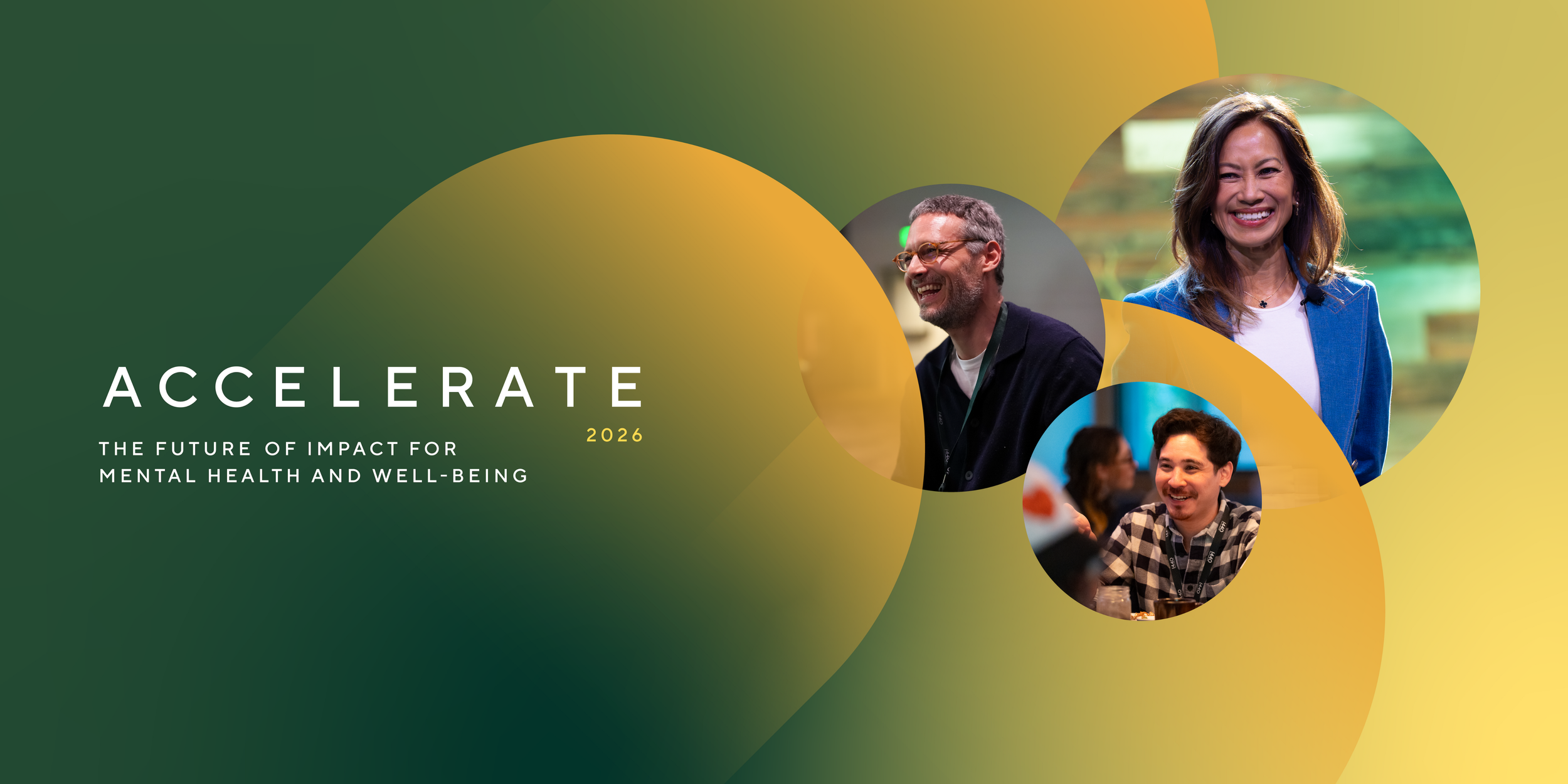
Accelerate 2026 Program
Day 1 - Monday, April 20th
All sessions are held in the Redwood Auditorium unless otherwise noted.
1:30 - 3:00 PM | Registration & Refreshments
3:00 - 3:15 PM | Opening Remarks
Mindful Philanthropy’s Chief Executive Officer, Alyson Niemann, will welcome guests to Accelerate 2026 and invite attendees into a shared journey shifting the mental health narrative from crisis to flourishing while establishing a set of priority areas to guide learning, connection, and action throughout the convening. Attendees will also hear from a1440 Multiversity representative on the history of the land and Multiversity’s mission to ignite energy, discovery, and creativity to help individuals and communities flourish.
3:15 - 3:35 PM | Arriving with Purpose, Presence, and Possibility
Alyson Niemann will introduce the event emcee, Tekitha Wisdom, and together they will explore what it means to lead, fund, and invest in mental health and well-being during a moment of profound urgency and possibility. Drawing on Tekitha’s lived experience, creative practice, and work at the intersection of healing, culture, and community, the conversation will surface themes of presence, resilience, and human connection as essential foundations for systems change.
3:35 - 3:55 PM | Grounding in Flourishing Across Cultures and Contexts
In this session, Glen Comiso will explore how flourishing is defined and measured across cultures and contexts, with a focus on the relational, spiritual, and community dimensions that shape well-being and mental health outcomes. He will reflect on what a growing body of evidence reveals about the conditions that help people truly flourish, and how these insights challenge prevailing assumptions about impact, success, and progress. The session offers a shared starting point for understanding flourishing as a multi-dimensional outcome and a foundation for rethinking how systems and societies can better support human well-being.
3:55 - 4:25 PM | Interactive Reflection: Experiencing the Architecture of Flourishing
In this interactive reflection, attendees will experience the multidimensional framework of flourishing firsthand. After completing a brief self-assessment, attendees will reflect in small groups on how different dimensions—relational, material, spiritual, and physical—shape their sense of well-being. The session will close with a full-group discussion of what shifts when we view mental health through the broader lens of human flourishing.
4:25 PM - 4:35 PM | Break
4:35 - 5:10 PM | Financing Upstream Solutions at Scale
In this session, Dr. Tiffany Manuel and Dr. Carley Riley will join Tyler Norris to explore a bold approach to outcomes-based financing that is building the financial architecture for sustainable investment in children, family, and neighborhood flourishing. The session will highlight how philanthropy can help unlock large-scale private capital to support what works over the long term.
5:10 - 5:30 PM | The Protective Power of Relationships
Drawing on research and real-world practice, Dr. Benjamin Houltberg will reflect on a central theme of the convening: the role connection and relationships play in human flourishing. He will explore how relational health across families, communities, and institutions serves as a powerful protective factor, fueling resilience, strengthening belonging, and creating the conditions for long-term well-being. Dr. Houltberg will invite funders to consider how strengthening relational ecosystems can shape more effective strategies for advancing youth mental health and community well-being.
5:30 - 6:30 PM | Break
6:30 - 8:00 PM | Cocktail Hour & Dinner - Location: Kitchen Table
The Common Grounds Cafe will remain open until 10:00 PM.
Day 2 - Tuesday, April 21st
All sessions are held in the Redwood Auditorium unless otherwise noted.
7:00 - 7:45 AM | Signature Wellness Classes
7:30 - 8:45 AM | Breakfast - Location: Kitchen Table
8:00 AM | Optional Breakfast Roundtable: Advancing Mental Health through Faith Communities
9:00 - 9:20 AM | Changing Outcomes through Prevention and Early Action
Award-winning physician and public health leader Dr. Nadine Burke Harris will open by making the case for a paradigm shift toward prevention, early detection, and risk-based approaches to mental health and well-being. Drawing on her experience as California’s first Surgeon General, she will use the ACEs Aware initiative as a concrete example of how systems change happens. Dr. Burke Harris will close by underscoring the critical role philanthropy can play in catalyzing innovation, sustaining cross-sector coalitions, and helping states build and scale reimbursable, equitable, and prevention-focused systems nationwide.
9:20 - 10:00 AM | Investing in Early Foundations for Lifelong Mental Health
In this discussion,Dr. Rahil Briggs, Dr. Nicole Bush, Becca Graves, and Ira Hillman will explore how early relational health, caregiver well-being, and supportive policy and financing structures lay the groundwork for lifelong resilience and mental health. Drawing on neuroscience, systems change strategy, and relationship-centered practice, panelists will examine how a two-generation approach can interrupt cycles of adversity while strengthening outcomes for both children and caregivers from the earliest days of life. The conversation will focus on how philanthropy can catalyze change, highlighting high-leverage intervention points, the role of flexible capital in bridging systems gaps, and practical entry points for funders.
10:00 - 10:30 AM | Reimagining Systems for Youth and Families
In this conversation, Sixto Cancel will join Jonas Thom to share how his lived experience has shaped his work to transform the U.S. child welfare system, with a focus on how data and emerging technologies can strengthen prevention and early intervention. Drawing on his leadership and advocacy, Sixto will explore how AI-enabled data collection, care navigation, and workforce extension can help identify risk earlier, target resources more effectively, and reduce unnecessary system entry while keeping families intact. Sixto will challenge philanthropy to play a catalytic role by supporting innovation, responsible technology adoption, and strategies that help unlock public dollars to scale prevention-focused solutions.
10:30 - 10:50 AM | Break
10:50 – 12:00 PM | Examining Youth Well-being in the Age of AI
Michelle Culver will present the hidden currents shaping youth development in today’s AI-driven digital landscape. Michelle will explore both the risks and pain points embedded in these systems, as well as emerging bright spots where technology and AI can be intentionally designed to strengthen human connection and youth well-being. Michelle will then lead an interactive session where participants grapple with a central question: Will AI strengthen human connection, erode it, or does it depend on how we design and govern it? This exercise will challenge funders to consider the principles that guide their participation in the digital and AI landscape, and how philanthropy can help shape a digital ecosystem that supports human connection and healthy development.
12:00 - 1:30 PM | Lunch - Location: Kitchen Table
1:30 - 1:50 PM | Centering Purpose, Play, and Belonging - Location: Redwood Amphitheater
Keeya Wiki will join Alyson Niemann to reflect on her experience as a young person seeking community, purpose, and connection to ancestry in a rapidly changing world. Keeya will reflect on what led her to join a kayaking team that would travel the world and train to complete the historic source-to-sea descent of the Klamath River. She will explore how play, time in nature, and connection to place serve as essential foundations for healthy development. Her story invites philanthropy to broaden its lens beyond intervention to invest in the relational and experiential conditions that help young people grow, thrive, and flourish.
1:50 – 2:50 PM | The Conditions for Flourishing: An Experiential Exploration
Youth well-being is shaped not only by programs, but by access to environments that cultivate embodied agency, creative expression, and connection. In this outdoor experiential session, attendees will participate in one of several guided experiences that explore these foundational conditions — through nature, movement, play, and creative engagement — and how they influence attention, emotional regulation, vitality, and belonging. Attendees will be invited to reflect on how philanthropy defines impact and to consider experiential, non-clinical pathways not as enrichment, but as essential conditions for healthy development.
2:50 - 3:30 PM | The Science of Experiential Pathways to Well-Being
Building on the experiential activities in the previous session, Tracy Ferron, Rob Jackson, and Mia Sundstrom will join Kristen Ward to examine the evidence connecting music, arts, play and sport, and nature-based experiences to positive youth development and mental health. When designed with quality, relationships, and access in mind, these pathways help build protective factors that support lifelong well-being. Speakers will discuss why these experiential approaches are not peripheral enrichment, but essential areas of philanthropic investment for anyone seeking to strengthen youth mental health at scale.
3:30 - 4:00 PM | Break
Attendees are invited to explore the 1440 Multiversity property—a space designed to inspire connection, reflection, and growth—offering time to process the day’s discussions, deepen relationships, and consider philanthropy’s role in driving meaningful change.
4:00 - 5:30 PM | Applied Learning Sessions
Through a selection of topical discussion forums attendees will have the opportunity to deepen learning and connect with peers around the practical levers philanthropy can activate to advance systems change in mental health and well-being. Sessions will explore approaches such as strengthening metrics and measurement, advancing equity-centered youth mental health, supporting state and cross-sector collaboration, leveraging data and AI-driven innovation, and unlocking new financing strategies. These applied conversations will explore how philanthropy can deploy its resources, influence, and partnerships to accelerate impact.
5:30 - 6:15 PM | Break
6:15 - 8:00 PM | Cocktail Hour & Dinner - Location: Kitchen Table
The Common Grounds Cafe will remain open until 10:00 PM.
8:15 - 9:30 PM | Live Musical Performance & Fireside Chat with Multiplatinum Artist, Rachel Platten
Day 3 - Wednesday, April 22nd
All sessions are held in the Redwood Auditorium unless otherwise noted.
7:00 - 7:45 AM | Signature Wellness Classes
7:30 - 8:45 AM | Breakfast - Location: Kitchen Table
9:00 - 9:20 AM | A Morning of Reflection and Integration
To begin the final day, Janna Bilski will guide attendees through a brief meditative practice followed by a full-group discussion, integrating insights, experiences, and connections from the prior day’s content. This session invites attendees to slow down, reconnect with what resonated most, and surface the ideas, tensions, and opportunities they are carrying forward. Together, attendees will clarify what feels most urgent and possible, laying the groundwork for a day focused on scale, coordination, and action.
9:20 - 10:00 AM | Scaling Integrated Pediatric Behavioral Health Across States
Itai Dinour, Bonnie Hardage, Anita Morris, and Shanna Shulman will join Deb Mahan to spotlight how sustained philanthropic collaboration helped scale an integrated behavioral health model from a single state to a multi-state effort—expanding access to youth mental health care while strengthening the frontline workforce. Panelists will explore how funders worked together to identify promising models, share learning in real time, and make strategic investments that allowed communities to adapt integrated care approaches within their own health systems and policy environments. The conversation will highlight what it takes to move beyond isolated pilots toward durable systems change.
10:00 - 10:20 AM | Activating Capital for Systems Change: The Tow Foundation
Frank Tow will reflect on The Tow Foundation’s evolution toward a deeper focus on youth mental health and well-being, a commitment to systems-level impact, and an intentional effort to cultivate the next generation of leadership within the foundation. Drawing on lessons from the $10M Innovation Fund and a refreshed grantmaking strategy, he will explore how funders can use flexible capital, funds, and portfolio-wide approaches to take calculated risks, accelerate innovation, and shift systems.
10:20 - 10:40 AM | Break
10:40 - 11:25 AM | Narrative as Infrastructure: Building the Future Mental Health Workforce
Finding your purpose as a young person setting out in the world has always been a daunting task. Mike Marriner and Abby Porth will highlight their partnership and the role Roadtrip Nation plays in expanding how young people discover, imagine, and access careers in the mental and behavioral health workforce. The session will include sneak peek clips from their upcoming documentary, and invites attendees to step back from technical solutions and consider the upstream, narrative-driven strategies philanthropy can support to help build the future mental health workforce.
11:25 AM - 12:00 PM | Closing Conversation: Where Philanthropy Must Lean In
In this closing session, we will reflect on key themes from the summit and explore how Mindful Philanthropy is translating this momentum into a next phase of coordinated action. Jill Hawley and Louise Langheier will join Alyson Niemann to emphasize opportunities for funders to align around shared priorities, engage in collaborative efforts, and contribute to a more connected and effective philanthropic ecosystem. Attendees will be invited to consider how they can stay engaged beyond the convening, through ongoing learning, peer connection, and collective investment to help accelerate progress toward flourishing.
12:00 PM - 1:30 PM | Lunch - Location: Kitchen Table

Thank You to Our Sponsors





About
Mindful Philanthropy was founded in 2020 with the mission to catalyze impactful funding in mental health, addiction, and well-being.
We are building a community of funders invested in solutions that integrate mental health and well-being so that all people have equitable access to the tools and resources they need to be well.
